
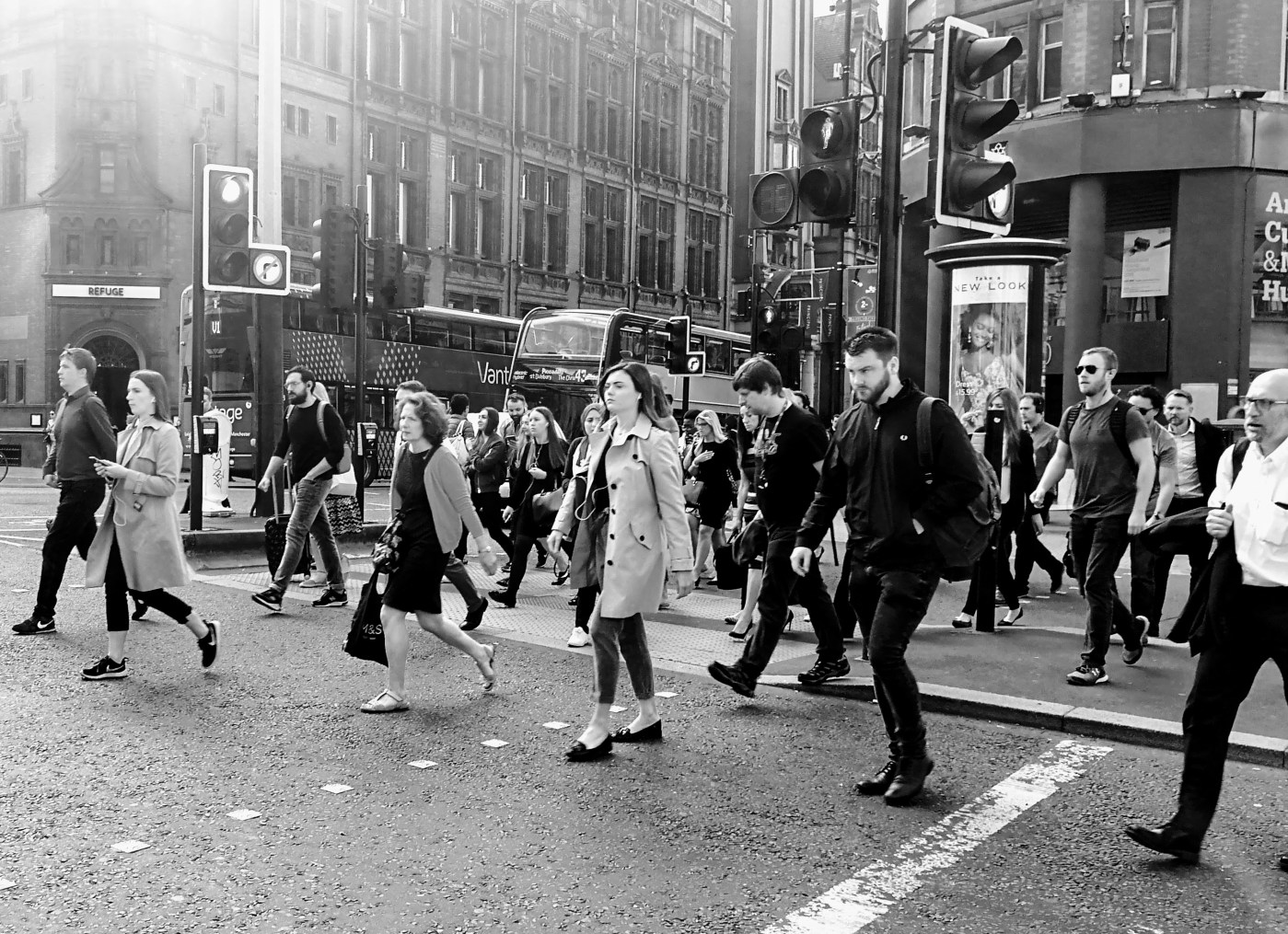
For Georg Simmel, the ‘blasé attitude’ which modern city life had caused people to adopt, was both necessary and limiting (Frisby, 2002; Allen, 2003). It provided a necessary means of affording cognitive navigability to urban space through limiting the ingress of stimuli into the urban subject’s field of awareness. This made urban life possible and also served to lubricate the pace with which activity in urban centres was conducted. The flows of money which had fuelled the formation of these urban concentrations, were also the major force determining the tempos of movement and interaction there (Frisby, 2002). In order to move comfortably and undisruptively in these currents, a collective detachment is required. A certain amount of slowing, noticing, halting, meeting and clustering, may be tolerable, but in the main a collective effort is underway and mostly adhered to, whereby people in urban space sense the importance of, and voluntarily contribute to, maintaining the pace of movement proper to the street – and a large part of how this is done is by maintaining a certain detachedness from each other.
Of course, there are modes of money-fuelled urban movement which require adjustments of pace. Tourism and shopping bring various sorts of pausing and focusing, slowing and gazing, browsing, crowding, searching, following and finding. Where this occurs, it’s as if the reduced contribution to the work of maintaining pace is offset by an increased performance of focus; if you’re slowing or stopping then it’s likely your purpose in doing so would usually be apparent to an observer: you’re looking at a street performer, you’re taking a picture of a building, you’re looking for a street sign, you’re gazing in a shop window, you’re greeting or talking to a friend. As pace declines and focus intensifies, detachment from the general presentness of others is maintained.
When both pace and focus are reduced, behaviour attains qualities that can span from relatively benign to impertinent, disruptive or threatening. People pause to rest from activities of pace or focus, and stand, lean or sit (if there’s somewhere to), smoke, read, eat, look at screens, or gaze about. In places where space is given over for people to sit in large numbers, or where the need to move in the general paciness of things is suspended, groups might accumulate and talk, play or mess about. For those not in groups or for those with others but whose conversation or play has paused, the suspension of engagement in pace and in focus brings the presentness of the urban scene as observable spectacle to the foreground. Of course ‘people watching’ can be undertaken anywhere there are people to watch and at any suitable moment, but its probably in spaces such as this where as an activity, disengaging from currents of pace and from specific targets of focus, allowing the gaze to meander and the spectacle to arrange and dissemble itself without necessarily wanting to see anything specific in it, and visibly beholding people – when not obviously engaged in another identifiable activity – is most explicitly and un-fleetingly indulged-in and is felt to be mostly benign.
At this point the urban spectacle is a screen in both its showing and its veiling senses. The act of watching with curiosity its general flux and its momentary constellations is prevented from impertinence by knowledge that our particularity is mostly unactivated – we’re gazing upon a spectacle we’re aware we’re a small-to-negligible component of. Impertinence arises when this relationship between generality and particularity is destabilised. This can happen when someone emerges from the spectacle and particularises somebody else, or the group they’re part of. This could be somebody coming and asking for money, or for for a light, or to hand out flyers – usually felt as friendly/benign-tending-to-uncomfortable (although this is also affected by ways in which class, race, gender, sexuality (dis)ability and mental health intersect in the interaction), and tempered by the fact that these interactions are expected to be swiftly concluded. It could also arise from the sense that someone’s people-watching has become overly particularised, that their focus has become improperly specific, making a person or group feel singled out on the screen of spectacle and thus more shown and less veiled.
Particularisation can also occur when a person consciously or otherwise draws the attention of a number of the spectacle’s participants. This could be through a person’s detectable anger or distress, intoxication or ill health; through their playfulness or rowdiness overstepping a certain level of general ignorability. This can provoke concern, amusement or annoyance, but might also provoke a sense of threat, not just that whatever’s transpiring might be discomfiting, upsetting, dangerous, but that whatever occurs might get to a point where a participant who’s within and veiled by the spectacle, might have to – to some extent – unveil and become involved.
An imperative to involvement violates the collective ‘truce’ that the blasé disposition, the generalised consensual detachment, is founded upon. Depending on the involving situation and on the person to whom the imperative to become involved has presented itself, this un-asked-for emergence from detachment could have effects ranging from minor to severe. The imperative to involvement ‘involves’ a person’s self being called upon to act or not act, with respect to another, or others, in such a way that they are or would be undertaking activity beyond the usual repertoire of behaviours associated with ‘detached’ interaction. Engaging in this action would be to reveal more of the self than is normally revealed and makes what is revealed subject to external assessment of adequacy. A fairly benign example might be that of a ball rolling within close range of a person’s feet from a nearby game of football. The imperative to involvement in this case may be experienced as an opportunity to offer amiable help that’s fairly straightforwardly dealt with, with little risk to their sense of self. It could also present a nightmarish reminder of being judged, excluded, laughed-at or belittled, which might occur again if the imperative is acted upon, and so the ball is left un-returned.[1] In the second case the imperative to involvement even un-acted-on still leaves an unhappy impression. But it could have been worse. If they had thought that by – this time – successfully kicking it back, they would have gone some way to redeeming some unhappiness from the past, and they had acted upon this and then failed once again – this may have had even more devastating consequences.
How this moment of public experience is felt and remembered (or forgotten) will be conditioned by these kinds of biographical factors, but also by the workings of history beyond them that mingle with and contribute fundamentally to how this biography unfolds. The specific cultural inscriptions that are made onto certain bodies, and onto certain types of mind or disposition, historically generated and reproduced with the constant rebirthing of culture, also have an inevitable effect on how bodies and minds feel and how people feel disposed to being and acting ‘in public’ (See Tyler, 2013). How people are racialised, how they are gendered, how their comportment is read in terms of class, how their bodies are read in terms of (dis)ability, how their minds might be read in terms of assumptions about mental health etc. places people in a field of unequal power and unequal risk. These things make the stakes of being in public and being involved very different for different people.
Relatedly but also distinctly, the ways in which a person feels aligned with or against the performance of normal repertoires of behaviour, and whether they imagine that these amount to something worthwhile or beneficial, or not, and the reasons they have for why they feel this, will determine how effortful participation in this performance feels and will also modify their thresholds for and expectations of various sorts of involvement. For example, a person who has a particular concern with road safety might more patiently perform waiting at a pedestrian crossing when the man is red, where there’s not any obvious risk from crossing, than somebody who is inclined to make their own judgement about risk and just get on with things in this situation. Also, regardless of what inclination they may have, a person’s ideas about what’s right to do in this situation may be overwhelmed to the point where they decide to just go along with what other people are mostly doing: if everybody else is crossing, then a person’s values regarding this may be outweighed by a desire to not look unusual.
On the other hand, a person could feel so strongly about this situation that they feel the need to unveil, particularise and become to an extent involved by visibly shaking their head or even verbalising their dismay at what’s happening. Further, the head-shaker and their target(s) will have a sense, accurate or otherwise, about how their position in this situation aligns with or against the grain of what’s viewed as powerful and authoritative in society, in terms of invokable values, in terms of what generally exercises people’s moral responses, and in terms of the ways relevant laws are likely to be enforced or not.
Though the relationship between the political and the interactional here is complex, and the connections between what’s occurring in such urban scenes and their participants’ broader ideas about what would be good for society are not necessarily neatly traceable, the existence of the political in these interactions is certainly present, to the extent that they would not be fully intelligible were it not looked for and accounted for. The general public ‘truce’ – the blasé disposition of un-involvement that constitutes such a vital lubricant to the normal functioning of everyday urban interaction, and the ways people adhere to or diverge from it – can be seen to be politically constituted and politically significant, even as its existence serves to veil – to a greater or lesser degree – this constitutive content. What’s more or less possible for people to do in urban space, in the flows along streets, moving through and spending time in its commercial and public settings could have been different and might yet be changed. The calculus of power and risk could be altered and the barriers and imperatives to different forms of involvement rearranged. What sorts of possible might become possible if this was consciously undertaken social project? What kinds of things could we make our urban spaces generate?
If a political choice was made, for example, to reduce the impact of finance upon the pace of urban activity, if the pressure and urgency it adds to urban movement was limited, then it’s plausible that there might be some softening of the blasé disposition and more openness to being affected by and wanting to affect the crowding realities of the city. A key part of what constitutes this disposition, and a key part of what contributes to the hegemonic pace of urban space, is a learned uninvolvement with people in evident distress, people evidently experiencing poverty, people vulnerable to cold, violence, exploitation and abandonment. Those who have already broken with detachment, who have become involved through devoting time to trying to give direct help to people suffering in these ways, are largely alleviating, mitigating or delaying suffering that society tends to keep generating. The infrastructures of care and support that they build are mostly under constant duress, struggling to meet the need that they are faced with.
The relentlessness of the reproduction of urgent need and the duress under which these efforts to mitigate it operate are fuelled by the same forces – and these forces are freer through the lack of friction that the pace of urban movement and the concomitant generalised detachment from each other affords it. It would be facile to say that we just need to ‘slow down’ in order to see each other in need and to become more involved in helping build the enduring structures required to meet these needs. But strategies for getting us closer to a point where such needs are not relentlessly generated have to take the pace of quotidian urban movement into account and not for granted.
[1] This sketch by Armando Iannucci offers a good illustration of one possible subjective experience of this scenario: https://youtu.be/FPUuqtOPDUE?t=72
 Ecologies of Possibility
Leave a comment