The phrase ‘ecologies of possibility’ popped into my head when walking around Manchester, doing fieldwork for my PhD. I was trying to conceptualise the way different traces of different eras of living are layered in the built environment, representing different rationalities of governance, different sets of material conditions, different possibilities for what might be.
I’d had longstanding difficulties whilst working on my PhD’s theoretical basis, relating to how I could talk about the things which were being lost, through ongoing application of neoliberal rationality to the social world by those with official/managerial/economic power over it, but without seeming to be overly yearning for a pre-neoliberal era. I wanted to express that what was lost mattered and had important things to say about where we socially are and where we’re socially going, but without coming across as nostalgic for what was still a time replete with gross systemic injustices.
I was walking through a Manchester suburb where a few independent businesses were clinging on along a street that gentrification hadn’t yet fully recharacterised.
Fieldnotes 10-07-22:
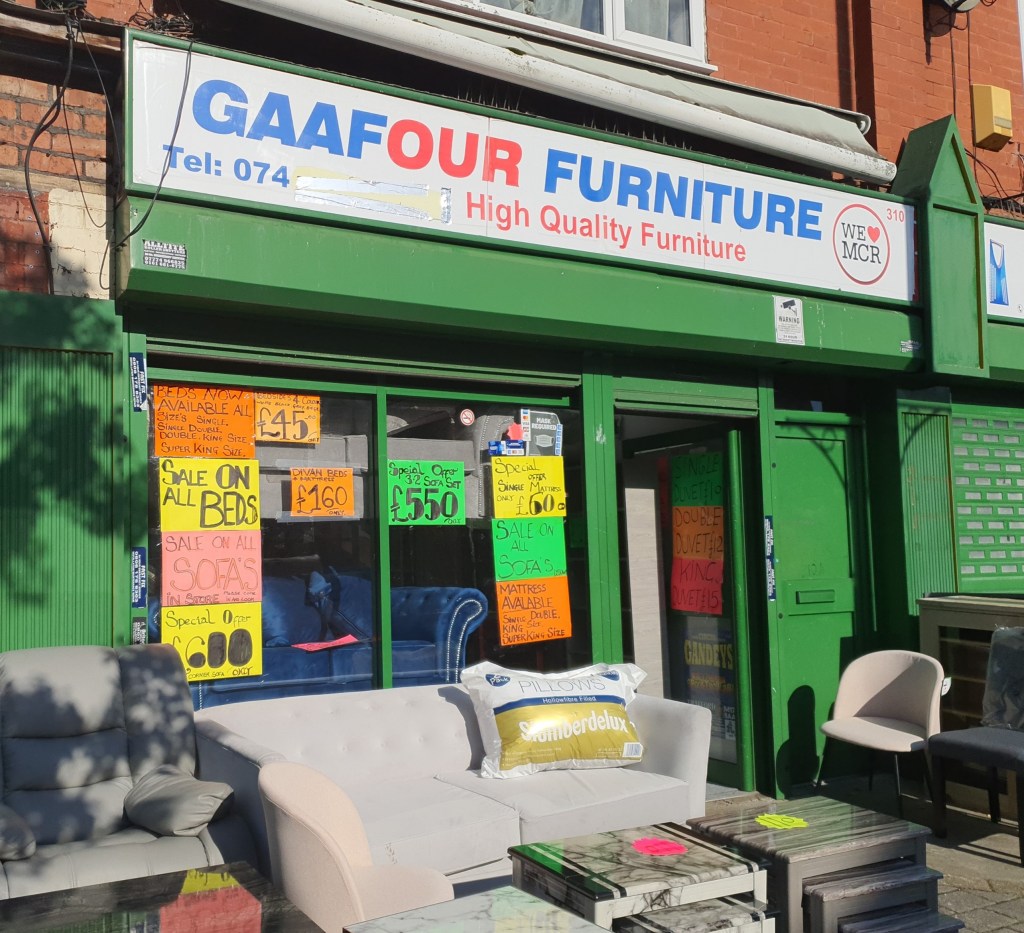
10:54 – And what is the difference between old-fashioned-ness and um… eliminated possibilities that… it’s important to feel should be noted because… they were important and… cause there are plenty of things are there not that are old fashioned, but which we wouldn’t mourn the loss of necessarily… but… these sofa shops with the signs in the window…
10:58 – Yeah, the traditional kind of um luminous, shaped cardboard little signs you put up and write on in marker… seeing that sort of thing, um, gives it a kind of um… community cosiness… sort of a sense that it’s not been repurposed… you know… fully repurposed… Yeah, what’s old fashioned and what’s lamentable… it’s even things that we wouldn’t miss were forged in and formed in… perhaps at some level amenable to other possibilities which are being chased out… Ecology of possibility… this is something I’m investigating isn’t it? Ecologies of possibility. There’s er… a destruction of them… and despite the fact that certain aspects of what is gone certainly shouldn’t be missed, but also… being an ecology… they’re kinda made of the same stuff, you know…
Later, on the last stage of the day’s walk, the font on the sign of a former business premises helped consolidate it for me.
17:19 – So we’re in a place of monumental commerce again… an enormous LIDL and B&M and then the um… Manchester Fort shopping centre I’ve just passed… the big roads, the… interminable pedestrian crossings and mega-restaurants… TEXET with its lovely old fonts… Elizabeth House… it’s not that things were better, it’s just that it all represents a die-off of possibility. A die-off of an ecology…
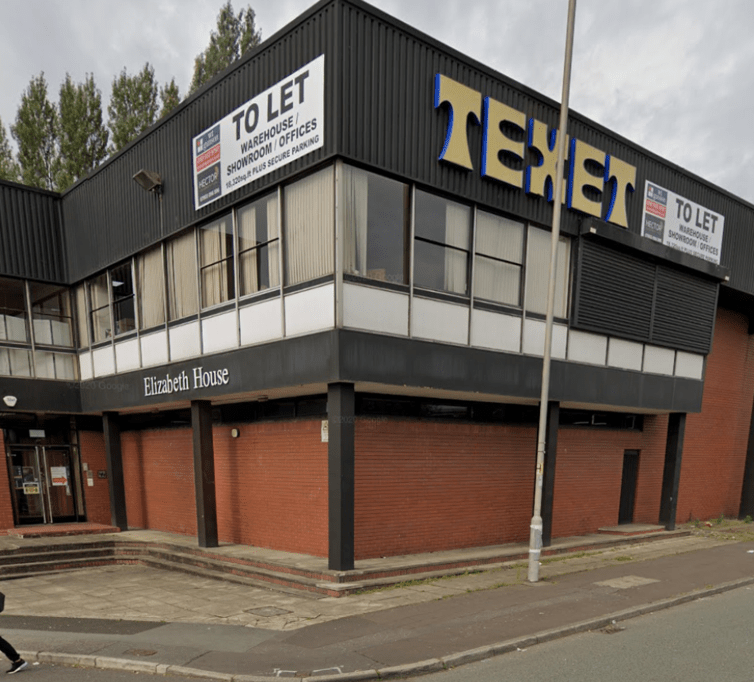
It’s stylisation was anachronistic, having a feel to it (to me) that seemed to straddle the late 70s and early 80s. As I looked at I had the sense that something of that period was emanating from this signage that the times had overtaken; it was still having some sort of compelling impact upon the place it inhabited.
Because I have a tendency to, I began thinking about the transition the UK underwent, from being a faltering social democracy, to becoming an authoritarian-populist led trailblazer for neoliberalism, and I thought of this sign as probably being fairly new and remaining so during the period of that transition. I was thinking about how the font was generating feelings in me that might well have been considered nostalgic, but that nostalgia didn’t seem to be quite the correct diagnosis for what I was experiencing.
The aesthetic signals sent out by this signage were expected to be effective in the context in which it was devised. In this context the sign would have been nothing extraordinary, it would have been doing the job of identifying this businesses premises in a mostly functional and hopefully pleasing way. A sense of what was a good choice for the font or not – of what was quirky, stylish, bold, excessive, dull, different, silly, serious, camp, drab or not – will have been more or less implicit for whoever in the business was tasked with sorting the sign/logo out and, presumably, will have been even more so for the designer or signmaker who finalised how it was going to look.
Constituting this sense of what looks good and what seems right for a sign for this business in this place, will have been a subtle and more or less unarticulated feel for ‘the times’. As well as a sense of contemporary style, this will also have been comprised of a broader sense of what’s going on: where society has been and where it’s going and how do these changes feel – are they hopeful, foreboding? This is something that I think people have whether or not they are particularly politically engaged or sociologically minded – there’s an alertness to changes in the wider fields of power and agency that influence ourselves and our communities that may be more or less consciously present to us, but which will nevertheless impact on how we feel about how ‘things’ are going.
Of course, lots of factors influence how clear and sharp this sense might be for any one person. And a signmaker/logo designer may consciously or unconsciously choose to disregard or pull away from any sense of the times they have when it comes to undertaking the job they’ve been given. But this sense of the times is not really ever the possession of any one person, it’s a complex, socially-cocreated mixture and shaping of transmitted experience – and as such it’s not straightforwardly incorporable into or excludable from any cultural artefact.
And something of ‘the times’ in which this sign had been made and into which it had been made to speak was emanating from it and mingling with ‘the times’ in which I was stood looking at it. The political, social, cultural and economic changes that it will have been a witness to represented possibilities being reshaped, actualised – generating and multiplying further possibilities, while others were thwarted, destroyed or placed into hibernation – disappearing from the future the possibilities that would have grown out of them from that point. The living possibility that was present when the sign was made was qualitatively different than that which was present now.
The ecology of possibility I was assuming the sign arrived in – late 70s/early 80s – for all the immense changes that have since taken place – differs most consequentially from our present in terms of the degree to which catastrophic climate change, the devastation it’s already brought and the now all-but inevitable devastation that will continue to occur in coming centuries, could have been avoided. At this point Exxon and other oil companies became increasingly aware of the potentially catastrophic consequences of climate change, if carbon emissions were not dramatically reduced. They had not yet begun their policy of actively promoting climate-change denialism. When the sign was (assumedly) designed, horrors of flood, drought, fire and extreme heat now already witnessed and set to intensify in coming decades, were not inevitable. Neither were climate change-triggered war and forced migration. The Arctic was likely to remain frozen for thousands of years. Coastal ecologies the world over, that are now quite likely to be underwater within 100 years, were – when this sign was made – not yet doomed. Real possibilities were living then that now no longer can.
Screening out the climate context (as those of us who can, do, much of the time), the period from the sign’s assumed creation through its arrival into our current shared moment appears as a mass of victories and disasters, various pools of horror, desperation, mundanity, drudgery, making and unmaking, hope and joy. Arcing over this all is the undeniable triumph of neoliberal (or financial) capitalism. The various possibilities this triumph destroys, banishes or diminishes, and the many, often-terrifying, often nightmarish ones it creates, cultivates and amplifies exist in a curious relationship with each other. Those that are suppressed or cancelled remain more or less detectable in anything that was created during the time of their greater realisability. Obviously, they hold a different sort of power than those that are favoured and encouraged, but I think the power they do have is nevertheless important and consequential.
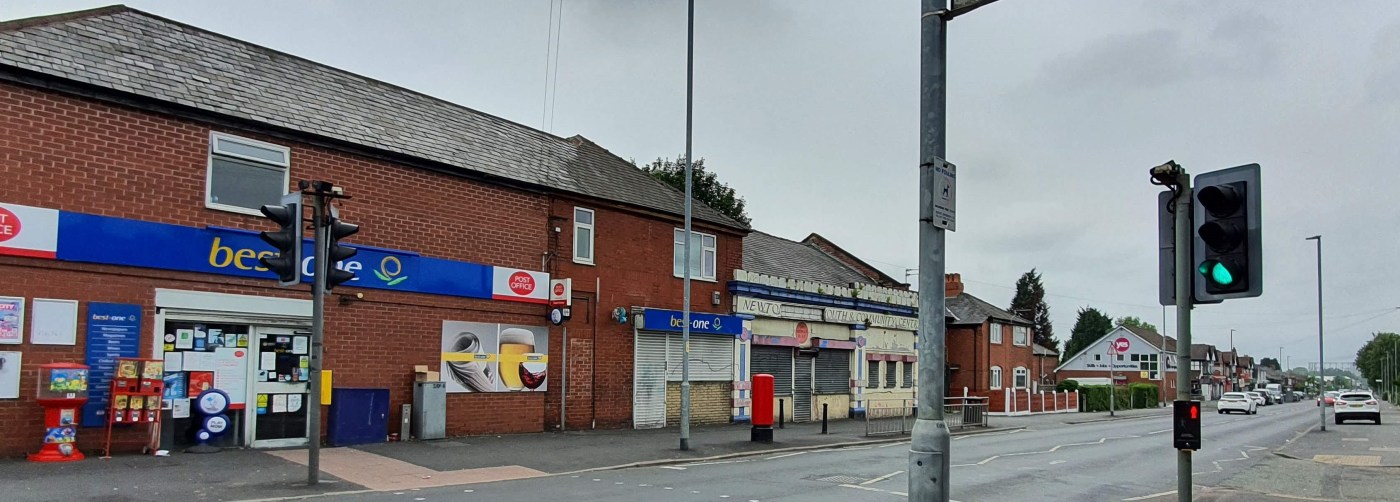
When undertaking my PhD fieldwork, which involved a lot of walking around in Manchester, I noticed the ways in which different sorts of possibility – those favoured and those suppressed – were particularly evident near a junction of this road in Newton Heath. I put the picture at the start of this post (and now it’s become the blog’s main banner image), but as I’ve taken such a long time to get to this point, it’s could well have faded from your memory, so here it is again:
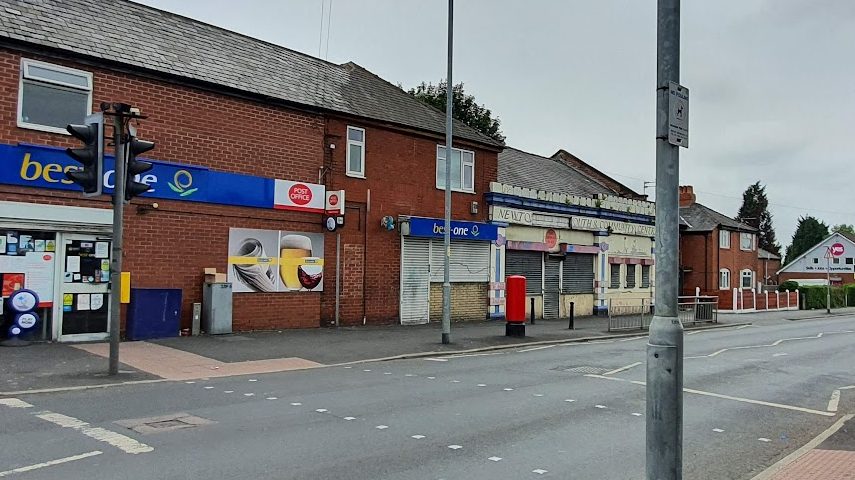
We have here a Post Office/Best One which acts as one of this area’s local corner shops, then next to this we have a run-down, older-looking building with a partly fallen-away sign that evidently said “NEWTON HEATH YOUTH & COMMUNITY CENTRE” in hand-painted, italicised capital letters. Not quite visible in the above image is a dusky pink circle above what was probably the front door, in which is written “THE PEOPLE’S PLACE”. Beyond that, over a side street, is a house and then further along, the triangular end of a building has the word “yes”, in lower-case white letters inside a dark pink circle. Not quite visible above, but beneath the little windows under the ‘yes’, in black letters is written “Skills – jobs – opportunities”.
People who have lived in the area a long time will likely be able to recall the youth and community centre being open and doing what it was intended to do. This may or may not have been somewhere with good associations for them. Either way this is important experience that will condition their sense of what its continued existence in this defunct state means. But it will also be having a more general public effect. The building in its evident dilapidation – its sign missing a sizeable chunk, the weeds growing from the edges of the roof – the clear difference in style the structure has in relation to what’s around it, and the explicit purpose it was supposed to have, are all sending clear signals about possibilities that are evidently no longer as realisable as they once were. And the surrounding buildings – the Post Office/Best One and the ‘yes’ building with its ‘Skills – Jobs – Opportunities’ – are sending messages out about sorts of possibility that are more realisable.
The youth and community centre, however it was perceived, will inevitably have contributed to this part of Newton Heath’s identity. It’s difference from its surroundings, the mildly snazzy sign with the area’s name there – these will likely have been more signifying of the identity of this neighbourhood than many of the more anonymous and fairly interchangeable buildings and bits of infrastructure around. This is something that you might expect the post office to be doing too, but its ability to do this is hampered by the sizeable Best One branding that occupies the majority of its signage. This subtracts from the sense of place that it could contribute to, because a Best One will struggle to ever be truly about the place it is in.
Best Ones and similar ‘Symbol Group’ retail suppliers supply a discounted repertoire of corner shop staples and offer various retailing advice and support, in return for the very visible branding on the shops they supply to. Any character and contribution to a unique sense of place such a shop could have had – through its specific range of stock and through its signage etc. – is heavily compromised by this. At most, a Best One signifies that this is a place like this: this is the sort of area that you find a Best One in. It also signifies that the post office/local shop combination can’t make it here without this kind of handing-over of identity and autonomy.
The post office does claw back some sense of locality and uniqueness through the posters and notes in its windows, some pertaining to local goings-on, and also through some marvellous, old-school sweet dispensers outside. The local notices relate to 1) a Facebook group that’s been set up to query some of the aspects of the Coronavirus Act (which as far as I can tell relates to unrelated curbs on civil liberties being bundled into the Act, rather than being about questioning the need for lockdowns, social distancing, masking, testing etc.) 2) Somebody selling a settee. There’s also a printed notice addressing customers that says “This is a respectable neighbourhood, please leave quietly” and another saying “Drugs aren’t acceptable in the premises”. The presence of these notices and the direct addresses to customers are actually quite atypical. The idea of a place set apart for local notices – things for sale, help wanted, work wanted, plans for a jumble sale, etc. is something that features in nostalgic post office imaginaries, but which I’ve seen scant evidence for in the 44 (or so) I’ve visited in Manchester and Salford.
The building proclaiming ‘yes’ to passers-by is one of three North Manchester bases for a charity that aims to help unemployed and under-employed people ‘improve their ‘access to employment, volunteering and learning opportunities, improve their digital skills, and achieve their ambitions’. However valuable those who find themselves engaging with ‘yes’ and its ‘digital champions’ find the service, its presence here is again sending a public message about this area being a place like this. The bases of this charity are all in areas of severe deprivation and will be transmitting a message that some strategic effort is being made to address some specific needs that arise because of this.
It’s not, of course, the case that long-underserved areas like this shouldn’t be targeted for specific help, but it’s important to note the mingling messages about a place that are consequently detectable here and how they relate to the area’s specific ecology of possibility and the wider ecologies of possibility within which it is nested. The defunct youth and community centre, a remnant of some other ecology of possibility unable to survive into these times, sends a signal that juxtaposes and intertwines with the signals emanating from the ‘yes’ base, representing what is possible and what does survive. The post office’s presence, with its juxtaposition of thwarted locality and imposed anonymity does its own version of this mingled signalling.
Messages are presented to us, publicly, about the times we’re in and what’s possible within them, here and in a place like this. There’s a disciplining effect in this. As Ernst Bloch exhausively demonstrated, imaginations tend to reach beyond the limitations of what is and what tends to be the case. In a restricted ecology of possibility, imaginations peer beyond the restrictions and consider how things could be better, how things could be good, how reality could be in accordance with the capacities that we sense we have for better ways of living. But imaginations are disciplined by the constant repetition of how things actually are. Hints in the built environment that things could be otherwise, have been otherwise, were on-track to be different than they are now, excite the imagination – they beckon it to overcome limitations, but then a chastening palm is raised: if this was possible then it no longer is.
Things that do survive into this ecology, things that are present to address important needs, or are present to repair or mitigate evident damage, have to defer to certain symbolic and linguistic repertoires amenable to prevailing rationalities. And this must happen whether people like it or not. Formulaic means of profit-extraction from localities like this involve a mechanically reproduced erasure of locality via the bland gaudiness of a symbol group’s signage. The ‘yes’ group’s ritualistic recitation of ‘skills – jobs – opportunities’ is compliantly hopeful-sounding and effectively meaningless, except in its demonstration of deference to the big Other that demands such recitations are made. Most locals will have a sense of what skills are being offered, what opportunities these are likely to lead to and what the quality, and security of jobs that people around here tend to get, when they do get them, are. For some, undoubtedly, this will be a call to which they are drawn and which might provide a genuine, even life-changing, alteration of possibilities. But for many, the invocation of this mantra will represent little more than insult to injury. Over and above these effects, is the knowledge that this language and what it represents must be adhered to in order to navigate the official routes out of deprivation.
And objects from lost ecologies of possibilities, or ecologies of possibility which have seen considerable die-off and degradation, can become allies in our refusal to submit to the disciplining of imagination that’s required of us. To mourn the loss or degradation of ecologies of possibility where their loss is due to something unjust, something that itself should be refused, is not to indulge in an unproductive nostalgia, it’s about refusing to accept that this injustice should be absorbed and neutralised in a disciplined accordance with the times. The artefacts that arrive with us in the present, from pasts that – along with all their own injustices – contained hopeful things now unrealisable, can still offer us some energy with which to fuel this refusal and to fight for whatever hope is left.
 Ecologies of Possibility
Leave a comment