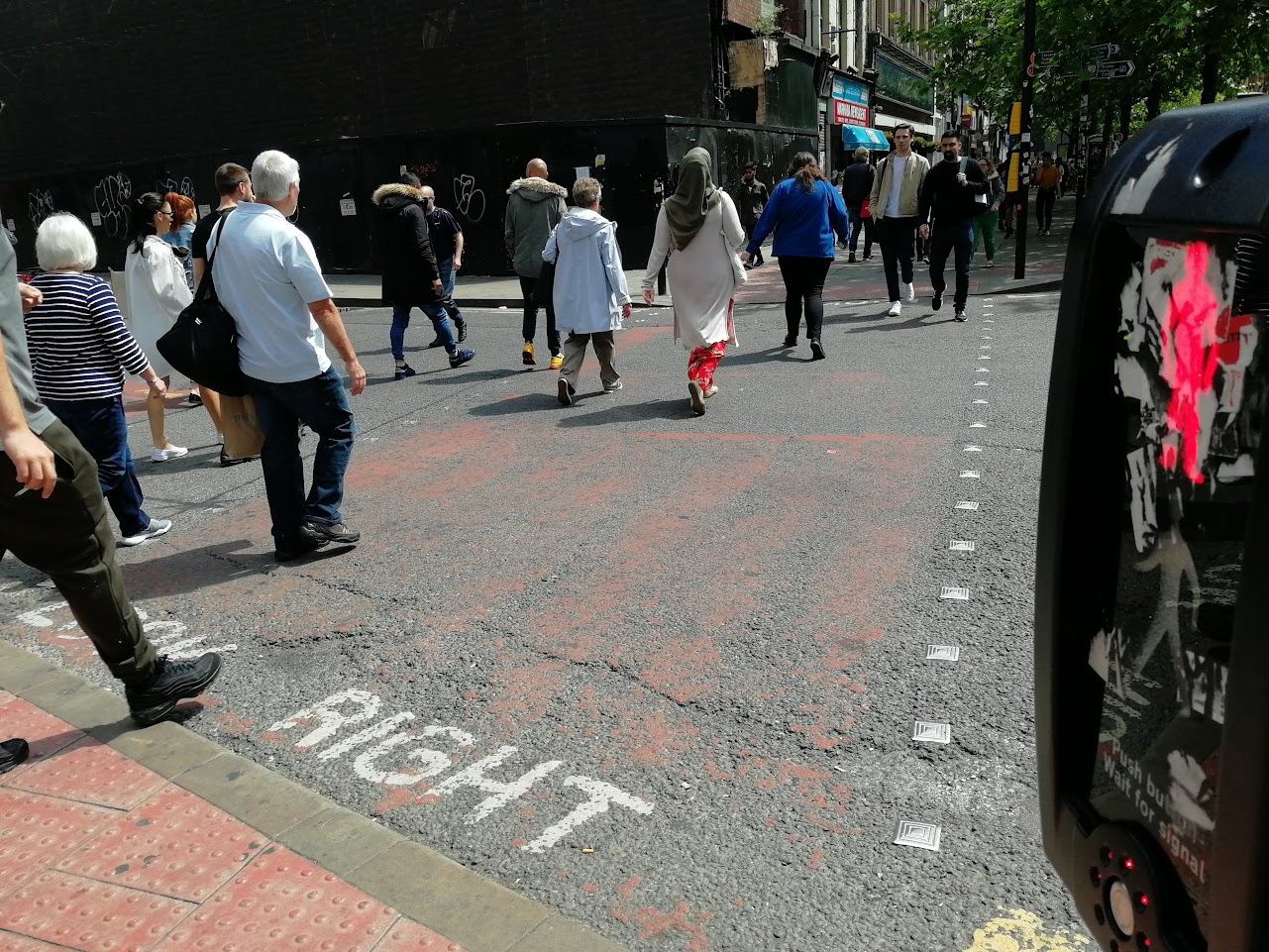
There’s a series of pedestrian crossings on the way to Piccadilly Station in Manchester where, due to the high flows of pedestrians at certain points in the day, there tends to be a fairly chaotic relationship between pedestrians and traffic. This stretch of street, the passing pedestrians, drivers, vehicles, the intersecting junctions and the infrastructure they’re all attached to contribute to a specific ecology of possibility, where certain things are more or less likely to take place. Things are as they are here because of space and because of history. They are as they are because of ‘the times’ and people’s sense of them, because of what’s ‘mainstream’ and because of people’s disciplined responses to these; they are as they are due to the specific material and cultural limitations sensed in this place and in society more generally.
Near misses between pedestrians and traffic are more likely at this set of pedestrian crossings than at many other places in the city, because the high flows of pedestrians at each often means that people are looking at each other for cues as to whether or not to cross, rather than the signals themselves. This can lead to confusion, errors of judgement and a hazardous impatience on the part of drivers inconvenienced by the flows of straggling pedestrians dashing or sauntering across when the ‘man’ is red. This situation is possible because of the specific history of pedestrian crossing infrastructure in the UK and the mainstream pedestrian crossing practice that has grown in the culture because of it. Mainstream pedestrian crossing practice in the UK involves taking the signals as being pretty much advisory and mostly making your own judgement about whether or not it seems ‘okay’ to cross, which includes going along with what people around you seem to be doing. This crossing culture causes some problems at this particular set of intersections on the way to the station, which would probably be a lot safer, with flows of pedestrians and traffic moving more smoothly and less hazardously, if a more disciplined response to the red and green ‘men’ was common as it can be in some other countries.
This practice itself becomes a discipline. I’m aware of very reasonable people becoming exasperated at the sight of people waiting at a crossing when the ‘man’ is red but where no traffic seems likely to interfere with their safe crossing. If a person was to suddenly stop, in one of these large pedestrian flows, because they were obediently following the signals as the man changed from green to red, they would immediately sense that their behaviour seemed odd – at odds with the majority and the mainstream practice. They might even get a disciplining look or a harsh word if someone was immediately behind them as they halted. How this was delivered and how it was received would depend to a degree upon how the parties involved viewed each other in terms of apparent gender, class, (dis)ability, racialisation, age etc.
This all takes place within a determining ‘times’. Even in this mundane scenario, what takes place in terms of mainstream practice and people’s dispositions relating to it, will be conditioned by ‘the times’. Our current times, our UK portion of them, might be summarised as: decades of neoliberalism in which local governments and public authorities and institutions have been restructured according to ersatz private sector templates, in many cases largely defunded, and with many services outsourced, processes which have latterly intensified due to austerity; this has occurred in a prevailing governance culture in which consumer choice and individual responsibility has been viewed as a superior and more ‘modern’ way to organise society, as opposed to nurturing a sense of public citizenship, bolstered by collective contribution to state-provided, universal benefits and services.
I’m not angling here towards the suggestion that the problems at these crossings is caused by people using them in a ‘neoliberal’ way… not 100% anyway. I do think that it would be difficult, however, to say with complete certainty that these broader political shifts and their consequent cultural effects can be separated from what’s going on here.
We’ve moved a long way over several decades from the sort of paternalist governance that is remembered as characterising the pre-neoliberal era. The commonness of public information films, the more frequent encounters with various aspects of the state and ‘officialness’ in routine life – things the progenitors of the Thatcher revolution were squirming to free people from – these will have contributed to a different set of collective meanings, a different mainstream, within which the presence of something like a pedestrian crossing, with its ‘official’ message about when it’s okay to cross, will have been understood. This will not have mechanically determined people’s behaviour here, with people’s crossing habits becoming markedly different from the moment Thatcher broke the ‘postwar consensus’ within which this mainstream understood itself. It will, however, have influenced over time the context of meaning this infrastructure had for people and to some extent, ultimately, their response to it.
A shift in the ideas about what’s powerful, what’s right, what’s just, what’s outrageous, what’s shameful, what’s decent, what’s valued, what’s modern – what’s in line with the times and what’s anachronistic – is something that can come with a change of government, and of governing ideology, not just because these different sets of values are espoused by that government and people just agree, but because these values have achieved power and are seen to remain powerful. Whether or not people are disposed to go along with this newly powerful ideology, it’s nevertheless there acting powerfully upon the world affecting lives and this brings its own orienting force to bear on what people think and feel. For some it will harden their resolve against this shift and what it represents, for others it will increase their strategies of defense against feeling like this sort of power matters to them; for others it will wear down the resistance they have to what this ideological reorientation means because of the friction that can come through feeling out of alignment with the mainstream, and for others, of course, it will vindicate and embolden their sense of how things should be, now the things that they think are true and good are being constantly legitimised by their invocation by those at the helm of power.
In a society where ideas regarding the legitimate role of a citizen have shifted away from ideas about collective contribution to a social good, towards individualistic pursuit of the good life, with a punitive disdain shown for those who don’t succeed in or align with this ethos, it would not be surprising to find an emboldening of individualistically-oriented dispositions such that these were more likely to be expressed in routine social activity. It might seem contradictory to say that people crossing the road by looking at what everyone else is doing, rather than following the signals, is evidence of a pedestrian practice more influenced by individualism, but individualism is itself somewhat paradoxical, being always, inevitably, a response to what everyone else is doing. Relatedly, a glance at the state of play and a decision to move with the majority is something that is certainly not alien to a society in which markets have been lauded and freed from former constraints. What counts in the individualist, market-oriented society is the freedom to make the judgement without sensing unnecessary constraint and the sense that the decision was yours to freely make.
I doubt that interviewing the participants in the flow of pedestrians along this route to the station would necessarily churn up any overly Thatcherite ideas about how a person should cross the road. But there would be a variety of views expressed about what it means to ignore the signal and whether that’s something that people really ought to do or not. And this will be couched in a general set of ideas about pedestrian practice, good and bad, which is related to a broader ethical understanding about how people should ‘be’ in public space and what responsibilities people have to each other. I can say this fairly confidently having conducted a little research project into exactly this phenomenon for my Sociology MA.
Generally people had what I termed and ‘ethic of awareness’. This was, in my small sample, something that seemed prevalent and it comprised of a sense of pedestrian practice being good or bad depending on an axis of awareness of others. People were deemed bad pedestrians when they showed unawareness of the needs of their fellow travelers and people judged their own practice as good because they themselves were studiously aware, whilst these other people fell short. People were generally against the idea of there being more of a social obligation to do what the signals at pedestrian crossings suggested they should, often seeing the idea of this as somewhat infantilising. People liked to be in charge of their own awareness, it was part of their sense of doing good pedestrian practice, and weren’t enamoured with the idea of outsourcing it to the state when arriving at a crossing. They liked to still feel they were in control and the idea of not being in control was frustrating.
This ethic of awareness, together with the discomfort shown towards the idea of a more ‘paternalistic’ idea of pedestrian crossing practice, could be said to contribute to a mainstream understanding of pedestrianism in the UK. The sample used in my research was way too small to claim this as a nailed-down social scientific fact, but I’m willing to bet these notions are fairly prevalent. If these things do contribute to the mainstream of UK pedestrian crossing practice, then they will clearly be contributing to the conduct witnessable at the series of pedestrian crossings on the way to Piccadilly – they will be a key aspect of the ecology of possibility here. Should someone want to alter what’s going on here, should they worry about the fairly hazardous and chaotic-seeming relationship between pedestrians and traffic here and want to change how people want to respond to the signals, the ethic of awareness and the discomfort about the idea of a greater obligation to observe the ‘official’ take on when it’s okay to cross, could be cited as reasons why this could or should not be undertaken, or could challenge the viability of any changes that were enacted.
The strength of this mainstream and its likely alter-ability, will undoubtedly be drawing something from the prevailing ideological conditions and people’s sense of what’s powerful within them. These are conditioning and invokable resources through which to make sense of and evaluate situations, whether or not the situations seem in or out of alignment with them. The ethic of awareness with its disdain for those who are unaware, could be said to resonate well with prevailing neoliberal ideas about self-discipline, personal responsibility and the sense that society is being let down by undisciplined sorts who ruin it for the rest. There might also be a counter-resonance detectable here, activatable in an altered set of prevailing ideological conditions, as yet lurking latently. The intuitive ways that the crowds process organically, managing the complexities of each other, the street furniture, etc. without much apparently active ‘awareness’ suggests a possible reinterpretation of the scene, whereby people are happy to temporarily cede some of their individual control in a situation where the conditions favour becoming instead a part of a collectively-constituted flow. If the ecology of possibility was altered at the level of these prevailing conditions of ideology and power, and people’s interpretations of what was going on here were in-part derived from these, might things then work differently here?
The breakdown in crowd-choreography that occurs at these intersections exposes individual moments of confusion, uncertainty, hazard, indecision, as people are snapped out of their flowing mode and faced again with their need to make an active judgement about what to do. This might be considered part of the cost of our crossing culture. A minority of people at each intersection will experience some momentary awkwardness, or perhaps the embarrassment of being beeped at, or some version of feeling left-behind after they hesitated at the crossing as the group they are a part of dashed ahead. They might feel compelled to break into a trot partway across, as they sense the change in who’s deemed to have legitimate right to momentum, from pedestrians to traffic. Individually these things won’t be experienced as something that matters so much, certainly they’re not going to spoil anyone’s day. Collectively, there could be said to be some aesthetic dropoff here as the crowd-choreography is disrupted, including an implicit message that there’s no repertoire beyond flow that the crowd can self-coordinate, but I suspect not many will be noticing and reflecting on this with disappointment.
There are more obviously serious consequences, of course. There have been collisions here, particularly at the Lever Street intersection, with several pedestrians injured over the years including one pedestrian, a 75-year-old man, killed by a coach in 2018. In the following court case it was noted that the pedestrian was crossing ‘against the signals’ and that this was ‘common’ practice among pedestrians here. The prosecution had it that the coach driver’s familiarity with the intersection, and – implicity – with people’s unmindfulness of the signals here, had created a neglectful attitude of contempt and as such he didn’t exercise any ‘degree of care or caution’ in the moments before the accident.
Spend an hour at a busy time at this intersection and you’re pretty likely to see a near-miss that bears some resemblance to what seems to have happened in this tragedy. It’s clear drivers have to exercise some degree of assertiveness and apparent insensitivity to the proximity of still-crossing pedestrians as they turn onto Lever Street. This has been normalised for them. It’s clear that mainstream crossing practice, and the ethic of awareness that comprises part of it, isn’t constituted such that it will prevent such accidents, or the conditions that make them more likely to happen.
I should make it clear here that I know nothing much about this accident beyond the details sketched above, and that the coach driver was found not guilty of death by dangerous driving. I’m not trying to make any judgements about the rights or wrongs of the case or the verdict, but I do think it’s important to discuss any insight into the context in which it occurred. This accident happened a couple of months after I’d completed the fieldwork for my project, and the memories, notes and photographs I have of these crossings at that time are impossible to disentangle from what I’ve read about it. This context is refreshed for me when visiting the crossings now, because little seems to have changed.
I have the sense that there’s an acceptance that an accident like this is going to happen sooner or later and that this is preferable to making significant alterations to the ecologies of possibility that have made it likely. The material basis of our times, the disciplines arising from them and the mainstream crossing practice that has developed int the UK are all enmeshed with the physical, infrastructural makeup of this space, conditioning people’s responses to it. The disciplines associated with having to work, with having limited time to enjoy the legitimised relief and joy of consumption and leisure, contribute to the mainstream pace of movement in the city, and to the meanings and feelings associated with slowing and stopping, and to the calibration and evaluation of practiced patience and impatience. There’s an intensification of these dynamics in a society which has struck out for market-mediated individualistic pursuit of wants as the best solution to any lasting social malaise. There’s no socially proffered reward for enacting patience at these crossings, save, perhaps, avoidance of the quickly forgotten embarrassment that can come from mis-judging a crossing attempt, or some abstract sense that things might be better if everyone else did this. And there’s little social habituation to taking advice from ‘official’ signals which point towards this possibility. In these circumstances it becomes apparent that occasional injury, and even the occasional death, are just a matter of how things are – changing things would require adoption of disciplines that are contradictory to those that prevail.
So this ecology of possibility will retain something lethal and mundane. What hasn’t yet had the sufficient conditions for emergence here is a plausible co-created culture of hazard minimisation. There are various ecologies of risk in which some losses are deemed almost inevitable and so sadly acceptable – certain sports, certain cultures of drug use, etc. Of course there’s also the voluminous lethality of the phenomena of traffic itself, let alone the consequences of its emissions, through which a striking level of quotidian horror is normalised. There’s a variable influence of ‘the official’ over the grassroots or venacular cultures at play in the examples of risky activities listed above. The way that behaviour is modified or limited by infrastructures, laws and their enforcement is clearly significant in how traffic works, and also shapes what occurs within cultures of drug use. In sports, various official bodies, professional organisations influence how the activities associated with the sport play out at professional and organised competitive levels, and there will be practices and ethics at play in the ways that conduct is conducted in grassroots versions of these, and in other colloquial/amateur forms of engaging in somewhat risky fun and playful competition.
The interplay between the official and the colloquial here seems to be key for thinking about what might make a culture of pedestrian practice more or less likely to produce occasional, awful and avoidable outcomes. Paternalist public information campaigns, alongside displays of exemplary legal enforcement, were key to making the changes in driving culture that were witnessed in the UK, when drink driving became a much greater taboo than it had previously been, and front-seat seatbelt use became much more common. There’s a different dynamic here, however, with driving clearly being something that is done in public, with public effects, but with seatbelt wearing and being drunk being things that are enacted more privately, in the strange pod of semi-privacy that is formed by the physical (and symbolic) structure of the car. These things are discoverable by inquiring officials should there be a random check or in the case of an accident, but they wouldn’t necessarily be publicly witnessable – readily noticeable by the ethical gaze of other participants in the traffic. There’s consequently a much more subjective, individualised sense of relationship with the law, and the ethics it seeks to enact socially, at play here.
The practice of pedestrianism is, then, one in which the pedestrian is more bodily present in shared space, more immediately detectable to an ethical public gaze. But, barring a brief intermission during the first COVID lockdowns, there’s been very little positive emphasis on what’s ‘shared’ in public, in terms of spaces, infrastructures, services etc. as things shared and collectively contributed to, in the UKs neoliberal decades. There are responsible people and irresponsible people, good behaviours and bad behaviours, but these are generally framed in other terms than as being a poor or competent sharer of what’s public.
It’s possible to conceive of a different sort of pedestrian practice that might emerge if such consideration of what’s shared was more broadly socially emphasised. It’s possible to imagine people becoming habituated to sharing ‘the burden of patience’ at a pedestrian crossing, whilst the man is red, where the unfortunate and tricky-to-eliminate-shared problem of traffic is present, and so where a predictable uniformity, though frustrating, would guarantee everyone’s safety. This wouldn’t be likely achievable through paternalist public information films targeting pedestrian practice, as so much in society as currently configured contradicts the logics that would be required to apply to make it work.
And it would be somewhat unfair to ask people to equally share this burden. People aren’t rushing and averse to patience because it’s just more enjoyable to rush. People are rushing and averse to patience because there’s often pretty hefty consequences for people for not arriving somewhere on time, and these consequences are unequally severe. A person on Universal Credit, at risk of being sanctioned, might lose the chance of having any income for weeks or months, if they are late for an appointment at the Job Centre. An employee might be at risk of seeming unreliable and therefore more disposable, to a boss who doesn’t care about the circumstances that have made them a few minutes late to the office. Someone needs to get a gift in their lunch break or they will jeopardise a relationship that’s essential to their wellbeing. Someone who’s really been making an effort to be a good friend might risk making this possibility doubtful, if they leave their pal another five minutes longer, waiting outside the town hall. And in the general tempo of the struggle to get by and to enjoy whatever time there is for relaxation and leisure, a missed train or bus, a missed closing time, a shortened time for coffee with a friend, a shortened time for grabbing a sandwich, a missed opening song of a long-awaited gig – these things can ruin a day and they can contribute to an accumulation of stress, dissatisfaction, social-undernourishedness. So people try and avoid this where possible, through rushing.
In order to make a just, non-paternalistic, non-authoritarian intervention in this, in order for it to be acceptable for people to ‘share the burden of patience’ at a pedestrian crossing, there needs to be some relenting of the pace at which life, for most people, has to be lived. We need time to cultivate practices of sharing, time for collective tending to what’s shared and making it work well for people through the complex problems that have to be solved – traffic, for example – when making our way to a better shared future. The social salience of sharing needs to be widely re-epmhasised, and this directly contradicts logics of competitive individualism.
Changing the ecology of possibility at the set of pedestrian crossings on the way to Piccadilly would, then, most effectively be undertaken through altering the key drivers that make patience-in-mobility uncomfortable and through careful cultivation of a sense of respect and care for ‘what’s shared’ socially. This would necessarily include a de-intensification of work, involving less hours and days worked, with stress in and about work becoming viewed as the socially pathological phenomenon that it is, rather than as just part of the discipline we must accept. This would contribute to another necessary change: the dramatic easing of our rationing regime regarding time for leisure, rest and relaxation. Progress towards these goals is achievable to some extent within the broader capitalist ecology, and should be sought, but it would likely be temporary, localised and reversible unless the fundamental circuits of profit and exploitation which comprise it, are fundamentally challenged.
This isn’t to say that other measures are futile and shouldn’t be taken, of course if there’s a safer way of physically organising the space here then it should probably be implemented. But this would represent another layer of firefighting – another attempt to design away, and therefore in a literal sense, increase the concreteness of, a problem that shouldn’t be present, if it occurred in the absence of a broader process of ecological change.
 Ecologies of Possibility
Leave a comment